
Hair Cortex: What It Is and Why It Matters
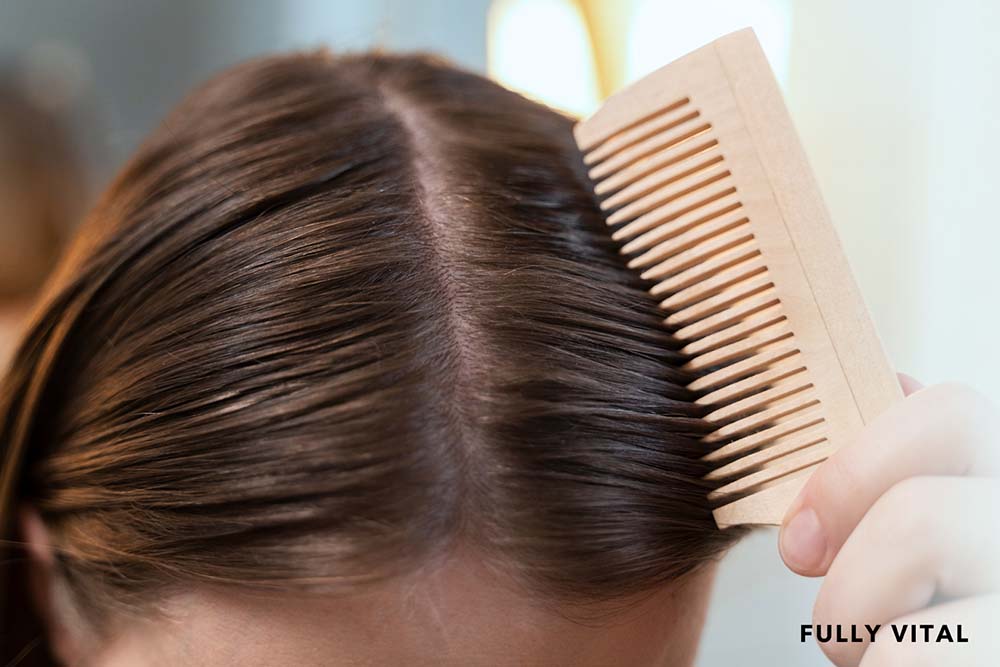
The cortex is the middle layer of a hair strand and holds most of its mass. It's where most of hair's strength comes from, and it is the layer that heat, chemicals and sun can damage once the outer cuticle is worn through. It is not something you can grow or "repair" with a product; it is part of the hair fiber itself.
Here's what research says about the cortex, the cuticle and medulla around it, and why that matters for hair care.

I LOVE MY HAIR NOW
FullyVital hair serum and hair vitamins made tremendous improvements in my hair. I truly love my hair now.
Meg S., 
Key Takeaways
- Each hair strand has three parts: a cuticle (protective outer layer), a cortex (the bulk of the fiber) and sometimes a medulla (a central core).
- The cortex makes up about 86 to 90% of the fiber by weight and is packed with keratin proteins.
- Hair's tensile strength is high (150 to 270 MPa) and depends on how fast it is stretched and on humidity.
- Hair structure varies from person to person.
What Is The Cortex Of Hair?
The cortex is the layer between the cuticle and the medulla. It's made of spindle-shaped cells filled with keratin bundles, and it contains most of the fiber's mass.

Why Does The Cortex Matter?
The cortex holds the bulk of the fiber, and the cuticle is its protective outer layer. For how heat and sun affect hair structure, see our articles on heat damage from styling and sun and hair care.


Protecting Your Hair's Structure
- Limit heat styling and chemical treatments.
- Protect from the sun.
- Be gentle when brushing and combing.

What The Research Shows
The Layers Of A Hair
Mammalian hair fibers divide into a cuticle, a cortex and sometimes a medulla. The cuticle is a thin layer of overlapping cells making up around 10% of the fiber's weight. The cortex makes up the remaining 86 to 90%, made of aligned, spindle-shaped cells packed with macrofibril bundles. The medulla is a column of spaces in the centre that becomes more prevalent as the fiber gets thicker (Plowman & Harland, 2018).
How Hair Structure Varies
X-ray diffraction studies of hair from different people, including parents and children and twins, examined how molecular hair structure differs by sex, color and waviness. The cortex contains the major part of the fiber mass, mainly keratin proteins and structural lipids, and the cuticle is a protective layer of dead overlapping cells (Yang et al., 2014).
Strength Of Hair
Human hair has a high tensile strength of 150 to 270 MPa, which depends significantly on strain rate and humidity. Under large tensile extension, the cortex's keratin structure changes, with the unwinding of the alpha-helix and a possible transformation to beta-sheet (Yu et al., 2017).
If you are curious about styling, see hair crimping.
See also: Fine Hair: What It Is and What Changes With Age · Does Brushing Your Scalp Make Hair Grow? What the Research Shows
For how each stage of hair growth works and how fast hair grows back, see our guide to the hair growth cycle.
Frequently Asked Questions
What is the cortex of hair?
The middle layer of a hair strand, between the cuticle and the medulla, holding most of the fiber's mass and strength.
Can you repair the cortex?
We found no study showing a product can rebuild a damaged cortex.
What is the medulla?
A central column of spaces in some hairs, more common in thicker fibers.
References
- Plowman JE, Harland DP. Fibre Ultrastructure. Adv Exp Med Biol. 2018. PubMed
- Yang FC, Zhang Y, Rheinstädter MC. The structure of people's hair. PeerJ. 2014. PubMed
- Yu Y, Yang W, Wang B, et al. Structure and mechanical behavior of human hair. Mater Sci Eng C Mater Biol Appl. 2017. PubMed
Revitalize Your Hair with Fully VitalUnlock the secrets to healthier, more vibrant hair with Fully Vital's cutting-edge hair growth products. Our mission is to provide you with powerful, science-backed solutions that slow down and reverse the aging of your hair, helping you cultivate a healthier relationship with your locks.
|
Read more
Pineapple for Hair: What the Research Shows
What bromelain from pineapple is, what research shows about it, and why there is no evidence that pineapple helps hair growth.
Read morePineapple for Hair: What the Research Shows
What bromelain from pineapple is, what research shows about it, and why there is no evidence that pineapple helps hair growth.
Read more
