
Why Does Hair Thin During Perimenopause? The Hormone Connection
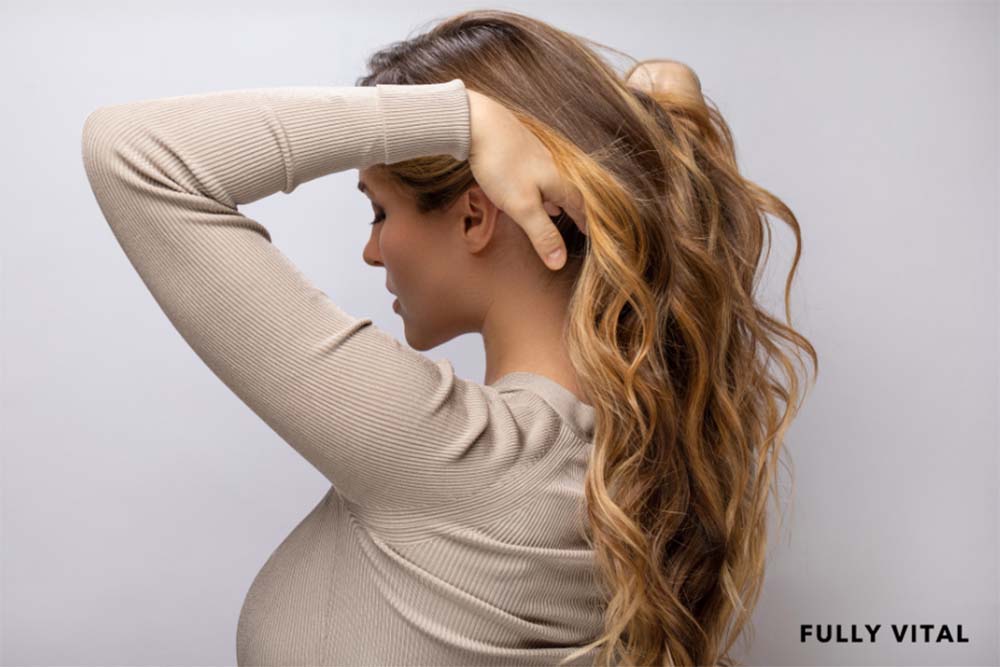
Hair thinning during perimenopause is real.
It has one clear hormonal cause.
Falling estrogen raises the scalp's sensitivity to DHT.
DHT is a hormone linked to shorter hair growth cycles.
Key fact: A 2023 randomized, placebo-controlled trial found oral maritime pine bark extract significantly improved hair density in menopausal women.

What Causes Hair Thinning During Perimenopause?
Perimenopausal hair thinning starts with falling estrogen levels.
Estrogen normally softens the effects of DHT, a hormone that can shrink hair follicles over time.
As estrogen drops during perimenopause, follicles become more sensitive to DHT.
This shift can shorten the hair growth (anagen) phase and thin new strands.
This process often begins years before your final period, during perimenopause itself.
Hair can thin gradually, strand by strand, rather than all at once.
Many women try biotin gummies or other hair supplements first, often without seeing real change.
FullyVital's Density Renewal System 30-Day is designed to support hair at these hormonal root causes.

The 6 Root Causes of Perimenopausal Hair Thinning
Perimenopausal hair thinning rarely comes from just one cause.
FullyVital groups the science into six root causes women can act on.
| Root Cause | What Happens in Perimenopause | How the Kit Targets It |
|---|---|---|
| Hormonal imbalance | Falling estrogen raises DHT sensitivity at the follicle | Saw palmetto in the serum and capsules targets the 5-alpha-reductase pathway linked to DHT |
| Inflammation | Hormone shifts can affect the scalp environment | Copper peptides and centella asiatica in the serum help support the follicle's environment |
| Circulation | Estrogen supports healthy blood flow to the scalp | Rosemary oil and caffeine in the serum are designed to help support scalp circulation |
| Nutrition | Nutrient needs and absorption shift with age | The capsules provide 20 vitamins, minerals, and antioxidants to help support the hair growth environment |
| Stress | Perimenopause often overlaps with high life stress | Ashwagandha in the capsules helps support the body's stress response |
| Gut health | Hormonal shifts can affect the gut microbiome | Prebiotics and probiotics in the capsules support the gut-scalp connection, an emerging area of research |

What Helps Hair Loss During Menopause?
Targeting the DHT pathway is one of the best-studied approaches for menopausal hair thinning.
Saw palmetto is designed to target the 5-alpha-reductase pathway associated with androgenetic hair thinning.
A 2023 randomized, placebo-controlled study in Clinical, Cosmetic and Investigational Dermatology tested oral and topical saw palmetto over 16 weeks.
The trial found reduced hair fall and improved hair growth in people with androgenetic alopecia.
Maritime pine bark extract is designed to support hair density and scalp microcirculation, based on published research in menopausal women.
A 2023 randomized, placebo-controlled trial in Health Science Reports found significant hair density improvement in menopausal women taking the extract, compared to placebo.
FullyVital's serum also contains Adenosine, clinically studied to help support increased hair thickness and a higher ratio of thick, healthy-looking hair strands.
A pilot, double-blind, randomized trial in The Journal of Dermatology found this effect in Japanese women with female pattern hair loss.
The serum and capsules are designed to work together on the follicle.
Consider the Density Renewal System 30-Day if you want a serum and capsule routine built around this same research.
"I have tried so many other products and nothing worked, but FullyVital gave me amazing results!"
Samantha K.
How to Stop Menopausal Hair Loss: What to Expect
Slowing menopausal hair loss takes consistency, not a single fix.
FullyVital does not promise complete hair regrowth, and no honest hair product should.
Genetics, thyroid health, and other root causes can all affect your results.
In a customer survey from April 2025, 95% of respondents noticed significantly less shedding within 20 days.
By day 60, 88% reported visibly thicker, fuller-looking hair.
By day 90, 85% saw new hair growth and improved density.
Most women should expect to see meaningful change over 3 to 6 months, not overnight.
A simple daily routine matters more than any single ingredient.
Skipping days here and there can slow visible progress, so consistency counts.
Prescription options like minoxidil and finasteride work through a different, pharmaceutical route and can carry side effects for some users.
FullyVital's approach targets the same root causes through natural, non-pharmaceutical ingredients instead.
Ready to Support Your Hair Through Perimenopause?
Perimenopausal hair thinning has a hormonal explanation, and a realistic path forward.
The Density Renewal System 30-Day pairs a topical serum with daily capsules built around that science.
FullyVital is backed by a 120-day money-back guarantee.
Try it risk-free for 4 months, and if you are not seeing results, you will get a refund.
FullyVital is recommended by over 150 dermatologists and rated 4.7 out of 5 by more than 21,600 customers.

The Density Renewal System 30-Day pairs the topical serum with daily hair capsules.
Each formula is manufactured without added hormones or drugs.
FullyVital's hair growth line is vegan and cruelty-free.
Every batch is third-party tested for heavy metals.
The serum and capsules are Non-GMO and made in a GMP-certified, FDA-registered facility in the USA.
Many women treat their hair like a health marker, the same way they track magnesium or vitamin D.
That is why manufacturing standards matter as much as the ingredients themselves.
Give the routine a full growth cycle before judging results.
Consistency is how you give your follicles a fair shot.
Most improvement builds gradually over 90 days, not overnight.

Frequently Asked Questions
Does menopause cause hair loss?
Menopause and perimenopause are strongly linked to hair thinning in many women.
Falling estrogen during this transition raises the scalp's sensitivity to DHT. If you're exploring treatment options, we cover HRT and hair loss in a separate article.
That hormonal shift can shorten the hair growth cycle and lead to visible thinning.
What helps hair loss during menopause?
Targeting the DHT pathway and supporting overall hair nutrition both help during menopause.
Ingredients like saw palmetto are designed to target the 5-alpha-reductase pathway linked to DHT.
Maritime pine bark extract and a nutrient-dense capsule blend support density and the follicle's growth environment.
How do you stop menopausal hair loss?
Stopping menopausal hair loss starts with consistently supporting the hormonal and nutritional root causes.
Most people need 3 to 6 months of consistent use to see meaningful change.
Genetics and other health factors can also affect how much improvement is possible.
Is hair loss from perimenopause permanent?
Perimenopausal hair thinning is often manageable rather than permanent for many women.
Supporting the hormonal and nutritional root causes early tends to produce better results.
A doctor can help rule out other causes if shedding feels unusually heavy or sudden.
When should you see a doctor about menopausal hair loss?
Sudden, patchy, or unusually heavy hair loss is worth a doctor's evaluation.
A doctor can check for thyroid issues, low ferritin, or other treatable causes.
Gradual thinning tied to the perimenopause timeline is common and often responds to consistent care.
Scientific References
The mechanisms and evidence described in this article are grounded in the published research below.
Cai C, Zeng B, Lin L, Zheng M, Burki C, Grether-Beck S, Krutmann J. "An oral French maritime pine bark extract improves hair density in menopausal women: A randomized, placebo-controlled, double blind intervention study." Health Science Reports, 2023. View Study
"Oral and Topical Administration of a Standardized Saw Palmetto Oil Reduces Hair Fall and Improves the Hair Growth in Androgenetic Alopecia Subjects, A 16-Week Randomized, Placebo-Controlled Study." Clinical, Cosmetic and Investigational Dermatology, 2023. View Study
Oura H, et al. "Adenosine increases anagen hair growth and thick hairs in Japanese women with female pattern hair loss: A pilot, double-blind, randomized, placebo-controlled trial." The Journal of Dermatology, 2008. View Study
Read more

Best Anti-Gray Products for Men in Their 40s
Most anti-gray products are not built for men in their 40s. The best ones target the actual biology behind graying - not just the look of it. And the science is clearer than most marketing admits. ...
Read more
Does Perimenopause Cause Hair Loss?
Perimenopause can cause real, noticeable hair thinning. This thinning traces back to a specific hormone shift. Falling estrogen raises the scalp's sensitivity to DHT. DHT is linked to shorter ha...
Read more
