
Can Gray Hair Be Reversed? What the Science Says

Gray hair can be partially supported — but full reversal is not yet proven.
The honest answer is more nuanced than a simple yes or no.
Science shows that some of the root causes of graying are addressable.
Key fact: A 2021 study published in eLife found that individual hairs repigmented during periods of reduced psychological stress, suggesting the pigment process is not always permanent.
That doesn't mean every gray can be undone — but it does mean the biology is more flexible than most people think.
No product, including FullyVital's, can promise full reversal of gray hair, and no peer-reviewed study has demonstrated it at scale. What research does show is that the pigment pathway can partially reactivate in some people, especially when graying was accelerated by stress, oxidative damage, or nutrient gaps rather than pure genetic aging.

Is Gray Hair Reversal Actually Possible?
Partial pigment recovery is biologically possible in some people, under the right conditions.
Hair gets its color from melanocytes (the cells that make pigment) inside each follicle.
When those cells slow down or stop working, the strand grows in gray or white.
For years, scientists assumed that loss was permanent.
The 2021 eLife study challenged that assumption directly.
Researchers at Columbia University analyzed individual hair strands and found segments where pigment had faded — then returned — in sync with changes in a person's stress levels.
This tells us the follicle's pigment machinery isn't always switched off for good.
It can, under the right conditions, be supported back toward activity.
Ready to give your follicles the right conditions? The Anti-Gray 30-Day Kit is designed to support your hair's natural color from the inside out.
What Actually Causes Hair to Go Gray?
Graying isn't one problem — it's five converging problems happening inside the follicle.
Understanding each one matters, because it reveals where support is actually possible.
1. Oxidative Stress and Free Radicals
Free radicals damage melanocytes over time.
The supplement's multi-antioxidant complex — including GliSODin, Glutathione, Astaxanthin, Selenium, and Polypodium — is designed to help defend the follicle against this free-radical damage.
2. Hydrogen Peroxide Buildup
As we age, hydrogen peroxide accumulates inside hair follicles.
This bleaches the strand from within.
The serum's Silverfree active helps reduce that peroxide buildup, while EUK-134 acts as a SOD/catalase-mimetic antioxidant to help neutralize follicular peroxide.
3. Stress
The eLife study confirmed what many women already feel: stress accelerates graying.
Rhodiola and L-Theanine in the supplement are adaptogens that support your resilience to everyday stress — the same stress research links to graying.
4. Declining Stem Cells
Melanocyte stem cells replenish pigment-producing cells in the follicle.
As those stem cells decline, so does color.
The serum's Eterwell Hair senolytic active helps support the scalp's stem-cell environment as hair ages.
5. Scalp Aging
A depleted scalp environment starves follicles of what they need.
Biotin, B-complex, copper peptides, and panthenol in the system help support a healthy scalp environment for vital-looking hair.

Proven vs. Not Proven: What the Evidence Actually Shows
Here is an honest look at what research supports and what it doesn't.
| Claim | Evidence Status | What It Means |
|---|---|---|
| Stress reduction can support pigment recovery | Supported (eLife, 2021) | Small study; individual hairs, not whole-head reversal |
| Copper supports normal hair pigmentation | EU-authorized (EFSA) | Copper is required for the enzyme that makes melanin |
| Antioxidants help defend against follicle oxidative damage | Supported (mechanistic) | Reducing damage may slow pigment loss |
| Gray hair can be fully "cured" | Not proven | No product or treatment has proven complete reversal at scale |
| Genetics determine all graying | Partially true | Genetics set the timeline; lifestyle factors influence pace |
The honest frame: graying is addressable at the root-cause level, not reversible by a magic promise.

Can You Regain Hair Pigment With Nutrition?
Certain nutrients directly support the biological pathway your body uses to make melanin.
Copper is the most important.
It contributes to normal hair pigmentation — this is an EU-authorized claim backed by EFSA (the European Food Safety Authority).
Without enough copper, the enzyme tyrosinase (which triggers melanin production) can't do its job.
L-Tyrosine provides the building block your body uses to support natural pigment production.
B-vitamins — especially B12, B6, and folate — support healthy melanocyte function from within.
Deficiencies in these nutrients are linked to premature graying in research.
Replenishing them doesn't guarantee reversal — but it does remove a barrier that may be slowing the process down.
Does Gray Hair Come Back Naturally?
In some cases, yes — particularly when graying was accelerated by a correctable cause.
Nutritional deficiency, extreme stress, and certain medications are known to trigger temporary or accelerated graying.
When those underlying factors are addressed, some people notice new pigment returning at the roots.
This is different from age-related graying, where melanocytes have been gradually depleted over decades.
In that scenario, full natural reversal is less likely — but supporting the remaining pigment machinery matters more than ever.
It's the difference between stopping the slide early and trying to climb back up a steep hill.
What a Science-Informed Approach Actually Looks Like
An inside-and-outside system designed to support your hair at the root causes of graying makes more sense than hoping one ingredient fixes everything.
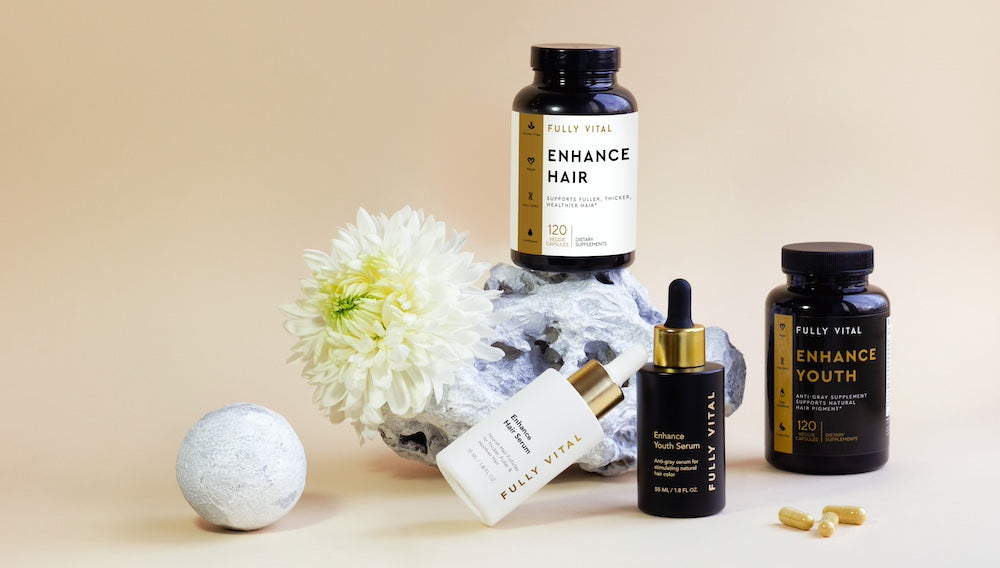
The FullyVital approach pairs a daily supplement with a topical scalp serum.
The supplement supplies copper, L-Tyrosine, GliSODin, Rhodiola, and a full B-complex to support your natural pigment pathway and your antioxidant defenses.
The serum delivers Greyverse — an α-MSH biomimetic peptide studied at 2% to support the hair's natural pigment process and the look of fewer grays — directly to the scalp.
It also includes Silverfree to help reduce hydrogen-peroxide buildup, and Eterwell Hair to help support the scalp's stem-cell environment.
Two clinically-informed formulas designed to work together against the root causes of gray.
In a customer survey from April 2025, 85% of users reported noticing fewer grays in 90 days, and 88% reported seeing new pigment at the roots in 60 days.
Results vary — and consistency is how you give your follicles a fair shot.
"My stylist has been amazed by the reduction in my grays — love these products!" — Jen H.
How Long Does It Realistically Take?
Hair grows slowly — about half an inch a month.
Any pigment changes happen from the root outward, so they take time to become visible.
Most people who notice a difference report it at the 60–90 day mark.
That's why the system is built around a full growth cycle.
Think of it like planting seeds — you don't see results the next morning.
Give it 90 days of consistent use before judging whether it's working.
The Anti-Gray 30-Day Kit is a low-risk way to start — and the 120-day money-back guarantee means you have four full months to evaluate, risk-free.

For the steps that can help slow graying, see our guide to how to prevent gray hair naturally.
For the most common gray-hair myths, and the difference between white and gray hair, see gray hair myths vs. facts.
Frequently Asked Questions
Can gray hair actually be reversed?
Full reversal of gray hair is not proven by current science.
However, research — including a 2021 study in eLife — shows that pigment recovery is possible in some hairs under the right conditions, particularly when graying was accelerated by stress or nutritional gaps.
A science-informed approach supports the root causes of graying rather than promising a cure.
Is gray hair reversal possible with supplements?
Supplements can help support the biological pathway your body uses to produce melanin.
Copper, L-Tyrosine, and B-vitamins are key nutrients that support normal hair pigmentation.
Supplementing them doesn't guarantee reversal — but it helps ensure your follicles have what they need to function.
Can you regain hair pigment after it goes gray?
In some cases, yes — especially when graying was triggered by stress, deficiency, or a temporary cause.
When those underlying factors are addressed, some people notice new pigment appearing at the roots.
Age-related graying is harder to reverse, but supporting the remaining pigment machinery may help slow further loss.
Does gray hair come back naturally after stress?
The 2021 eLife study found that some individual hairs regained pigment when a person's stress levels decreased.
This suggests that stress-related graying may be partially reversible — but the study was small and focused on individual strands, not whole-head results.
Adaptogens like Rhodiola and L-Theanine may support stress resilience as part of a broader approach.
How long does it take to see results with an anti-gray supplement?
Most people who notice a difference report it at the 60–90 day mark.
Hair grows slowly, and any pigment changes occur from the root outward.
Consistent daily use for a full growth cycle gives your follicles the best opportunity to respond.
Review the gray hair research studies here. Here are the gray hair glossaries here.
Scientific References
The mechanisms and evidence described in this article are grounded in the published research below.
Rosenberg AM, Rausser S, Ren J, et al. "Quantitative mapping of human hair greying and reversal in relation to life stress." eLife, 2021;10:e67437. DOI: 10.7554/eLife.67437 (Columbia University)
European Food Safety Authority (EFSA). "Scientific Opinion on the substantiation of health claims related to copper and maintenance of normal hair pigmentation." EFSA Journal, 2009;7(9):1211.
Wood JM, Decker H, Hartmann H, et al. "Senile hair graying: H₂O₂-mediated oxidative stress affects human hair color by blunting methionine sulfoxide repair." FASEB Journal, 2009;23(7):2065–2075. DOI: 10.1096/fj.08-125435
Trüeb RM. "Oxidative stress in ageing of hair." International Journal of Trichology, 2009;1(1):6–14. DOI: 10.4103/0974-7753.51923
Daulatabad D, Singal A, Grover C, Chhillar N. "Prospective analytical controlled study evaluating serum biotin, Vitamin B12, and folic acid in patients with premature canities." International Journal of Trichology, 2017;9(1):19–24. DOI: 10.4103/ijt.ijt_79_16
Read more
How To Use FullyVital Products for Optimal Hair
Short answer: Hair supplements and scalp serums are designed to be used together as one daily routine. The supplements are taken every day, and one or both serums are applied to the scalp every day...
Read more
Hydrogen Peroxide and Gray Hair: The Science Behind It
Your follicles make hydrogen peroxide naturally. Over time, it builds up — and that buildup is directly linked to graying. Most people blame genetics and stop there. The real picture is more action...
Read more
