
Postpartum Hair Loss Timeline: What's Normal and When to Worry
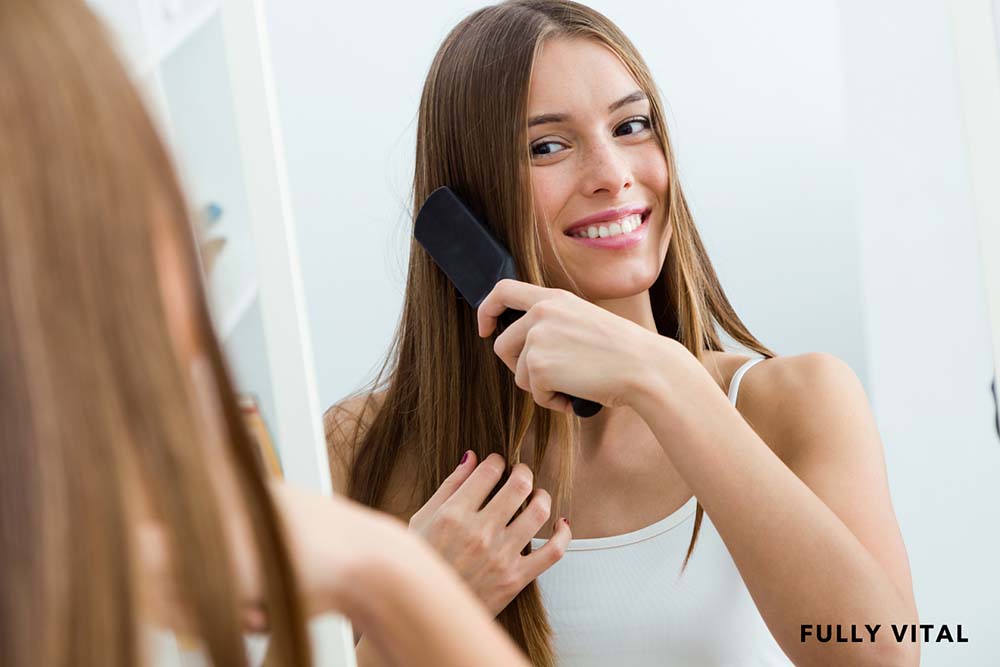
Postpartum hair loss usually starts around month 3.
It often peaks between months 3 and 4.
Most shedding stops within 6 to 12 months.
This timeline is normal, not something you caused.
Key fact: Postpartum hair loss happens because pregnancy's high estrogen delays normal shedding, then a rapid drop after birth releases that hair all at once.

When Does Postpartum Hair Loss Start?
Postpartum hair loss typically starts 8 to 12 weeks after birth.
During pregnancy, high estrogen keeps more hair in its active growth phase than usual.
That extra hair does not fall out on schedule.
Once estrogen drops after birth, all of that delayed hair shifts into shedding at once.
FullyVital's Density Renewal System 30-Day is designed to support your hair through this hormonal shift.
There is no drug-based cure for this kind of shedding.
Nutritional and scalp support can still meaningfully affect how well your hair recovers.
How Long Does Postpartum Hair Loss Last?
Postpartum hair loss usually lasts 6 to 12 months from the start of shedding.
Shedding tends to slow noticeably by month 6.
Full regrowth and thickness can take up to a year to feel complete.
Some women see their hair stabilize faster, especially with a consistent routine.
Others take the full year, and that is also normal.

When Does Postpartum Hair Loss Stop? A Week-by-Week Timeline
| Timeframe | What Is Typically Happening |
|---|---|
| 0 to 8 weeks postpartum | Hair is often still thick, hormones are still elevated |
| 8 to 12 weeks postpartum | Shedding usually begins |
| 3 to 4 months postpartum | Shedding often peaks |
| 6 months postpartum | Shedding usually slows down |
| 9 to 12 months postpartum | Hair typically returns to a normal growth cycle |
This timeline is a general guide, not an exact prediction for every body.
Breastfeeding, thyroid changes, and iron levels can all shift the pace slightly.
Why Does Postpartum Hair Loss Happen?
Postpartum hair loss happens because of a specific hormonal shift, not because of anything you did.
The medical term for this pattern is postpartum telogen effluvium.
Estrogen drops sharply in the days after birth.
That drop pushes a large batch of hair follicles into a resting phase at the same time.
Hair in that resting phase sheds a few weeks later, which is why shedding feels sudden.
Sleep loss and the nutritional demands of feeding a baby can add to the shedding.
"My bald spot is gone and I see so many new baby hairs! I feel so youthful!"
Dani H.
What Actually Helps During This Window?
Consistent nutritional and scalp support is the most realistic thing you can control right now.
Ashwagandha in the Density Renewal System 30-Day is designed to help support the body's stress response.
A 2026 randomized, placebo-controlled trial found ashwagandha improved hair density after 75 days.
Vitamin E, in its tocotrienol form, is designed to help support hair count.
A 2010 study in Tropical Life Sciences Research found tocotrienol supplementation increased hair count over 8 months.

The formula's 20 vitamins, minerals, and antioxidants are designed to provide essential nutrition for healthy hair.
Rosemary oil and caffeine in the serum are designed to help support scalp circulation.
Prebiotics and probiotics are designed to help support a balanced gut microbiome.
None of this speeds up the biological timeline itself.
A full growth cycle, generally 3 to 6 months, is the realistic window to judge results.
A sub-one-minute daily routine is the only kind most new mothers can actually keep up with.
When Should You See a Doctor?
Most postpartum shedding follows the timeline above without needing medical care.
A doctor's input is worth getting if shedding continues well past 12 months.
Patchy, localized bald spots are different from the diffuse shedding described here and deserve a closer look.
Many women use a scalp serum like this one while breastfeeding.
Your doctor or lactation consultant can confirm what is right for your specific situation.

The topical serum is one half of the kit and can also be used on its own.
It is applied directly to the scalp, not taken orally.
A sub-one-minute routine, once a day, is realistic even with a newborn's schedule.
You do not need a 14-step regimen to see whether a routine is working for you.
Two simple steps, done consistently, matter more than a complicated one.
The recovery you are looking for is gradual, not an overnight change.
Small, steady progress over several months is the realistic goal here.
A photo taken from the same angle each month can help you track real change.

You Are Allowed to Care About This Too
Loving your baby and missing your old hair can exist side by side.
Neither feeling cancels the other out.
The Density Renewal System 30-Day is a simple daily step, not one more thing to feel behind on.
FullyVital is backed by a 120-day money-back guarantee.
Try it risk-free for 4 months, and if you are not seeing results, you will get a refund.
FullyVital is recommended by over 150 dermatologists and rated 4.7 out of 5 by more than 21,600 customers.
Each formula is manufactured without added hormones or drugs.
FullyVital's hair growth line is vegan and cruelty-free.
Every batch is third-party tested for heavy metals.
The serum and capsules are Non-GMO and made in a GMP-certified, FDA-registered facility in the USA.
Frequently Asked Questions
When does postpartum hair loss start?
Postpartum hair loss typically starts 8 to 12 weeks after birth.
It happens once estrogen levels drop sharply after delivery.
The delay is why shedding often feels sudden.
How long does postpartum hair loss last?
Postpartum hair loss usually lasts 6 to 12 months from the start of shedding.
Shedding tends to slow noticeably by month 6.
Full regrowth can take up to a year to feel complete.
When does postpartum hair loss stop?
Postpartum hair loss usually stops between 6 and 12 months after birth.
Most women see hair return to a normal growth cycle in that window.
A doctor's input is worth getting if shedding continues well past 12 months.
Scientific References
The mechanisms and evidence described in this article are grounded in the published research below.
Jillella A, Keerthi N, Reddy JV. "A Prospective, Randomized, Double-Blind, Placebo-Controlled Clinical Study of Efficacy and Safety of Ashwagandha Root Extract Capsule on Skin and Hair Health in Healthy Adults." Phytotherapy Research, 2026;40(8):4946-4959. View Study
Beoy LA, Woei WJ, Hay YK. "Effects of Tocotrienol Supplementation on Hair Growth in Human Volunteers." Tropical Life Sciences Research, 2010;21(2):91-99. View Study
Read more

Best Ingredients for Stress-Related Hair Loss (Evidence Reviewed)
A handful of ingredients have real evidence behind the stress-hair connection. None of them work as fast as most people hope. Here is what the evidence actually supports, and what it does not. E...
Read more
When Does Postpartum Hair Shedding Stop?
Postpartum hair shedding usually stops between 6 and 12 months after birth. Most women notice it slowing well before that. The exact timing depends on a few individual factors. Here is how to te...
Read more
