
Why Is Gray Hair a Different Texture? The Science Explained
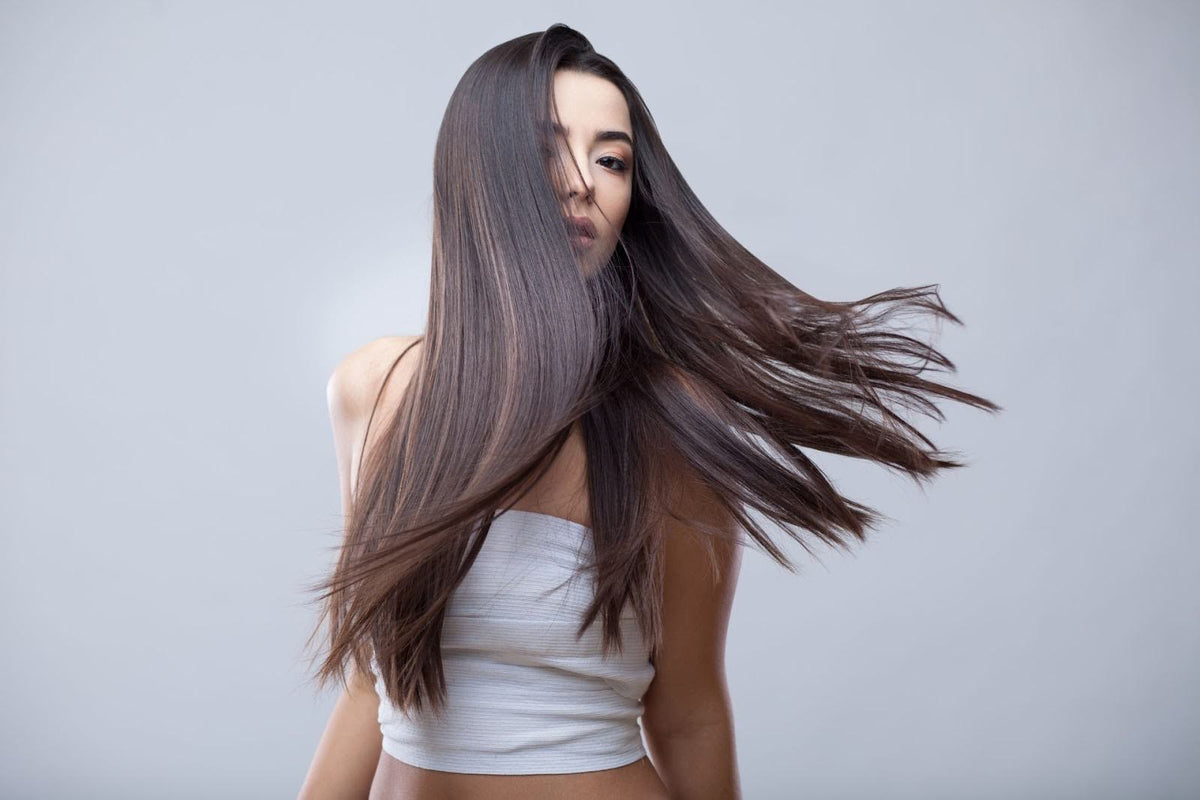
Gray hair really does feel different in your hands.
The change is biological, not imaginary.
Your follicle goes through real structural shifts as it stops making pigment.
Key fact: A 2009 study published in FASEB Journal found that hydrogen peroxide accumulates in aging hair follicles as the enzyme catalase declines.
Those changes affect texture, curl pattern, and how your hair responds to everything you put on it.

What Actually Happens Inside the Follicle When Hair Goes Gray?
The follicle does not just lose pigment.
It loses the melanocytes (the cells that make pigment) that once lined its inner wall.
Explore the Anti-Gray Serum, formulated to support the scalp environment those pigment cells depend on.
As melanocytes decline, the follicle itself narrows slightly and changes shape.
The result is a hair strand with a different cross-section than the one it replaced.
Melanin also acts as a natural plasticizer.
It softens and conditions the hair fiber from within as it forms.
Without it, the strand comes out stiffer and more brittle before it even reaches the surface.
Oxidative stress plays a central role in this process.
Research published in the International Journal of Trichology by Trüeb links oxidative stress directly to the aging of the hair follicle's pigmentation system.

Why Is Gray Hair Coarser and Wiry?
The coarseness you feel has two main sources.
First, the cuticle layers (the overlapping scales on the outside of each strand) lift higher on a pigment-free fiber.
Lifted cuticles catch on each other and on clothing, which reads as roughness.
Second, gray strands tend to have a different medullary structure.
The medulla is the central core of the hair shaft.
In pigmented hair it is often continuous and dense.
In gray hair it can develop air pockets, which changes how the strand bends and reflects light.
That is part of why gray hair can look dull alongside pigmented strands.
The sebaceous gland (the oil gland attached to each follicle) also tends to produce less sebum as we age.
Less natural oil on the strand means less of the lubrication that gives hair its softness and sheen.
Why Does Gray Hair Sometimes Turn Curly or Wavy?
The shape of the follicle opening determines whether a strand grows straight or curved.
A round opening produces a straight strand.
An oval or asymmetrical opening produces a wavy or curly one.
As the follicle narrows and reshapes with age and pigment loss, that opening can shift.
A strand that once grew straight may now emerge with a natural wave or coil.
This is especially noticeable at the temples, where graying tends to begin.
The texture change is not damage from outside.
It is a structural change from within the follicle itself.
| What Changes | In Pigmented Hair | In Gray Hair |
|---|---|---|
| Melanin content | Present, softens fiber | Absent or minimal |
| Cuticle position | Lies flat, smooth feel | Lifts, rough feel |
| Follicle shape | Consistent, stable | Can narrow or shift |
| Natural oil | Distributed along shaft | Reduced with age |
| Oxidative stress | Managed by catalase | Elevated as catalase declines |

Does Hydrogen Peroxide Buildup Make Texture Worse?
Hydrogen peroxide is a natural byproduct of cellular metabolism.
Healthy follicles manage it with an enzyme called catalase.
As catalase activity declines with age, peroxide accumulates inside the follicle.
The 2009 FASEB Journal study by Wood et al. showed this buildup is tied directly to the graying process.
Peroxide also degrades the proteins that give hair its structural integrity.
A strand weakened by internal oxidative damage is more prone to roughness, breakage, and dullness.
This is one of the five root causes FullyVital targets with its dual-formula approach.
The Anti-Gray Serum includes Silverfree and EUK-134, designed to help reduce the hydrogen-peroxide buildup associated with graying.
The supplement provides L-Methionine and a multi-antioxidant complex (glutathione, astaxanthin, selenium, and polypodium) to help defend the follicle against free-radical damage from within.
Can Supporting the Follicle From Within Help With Gray Hair Texture?
Texture starts at the root, literally.
The quality of the strand your follicle produces depends on what it has to work with.
The European Food Safety Authority confirmed in 2009 that copper contributes to normal hair pigmentation.
Copper is also a cofactor in the enzymes that help maintain the structural proteins of the hair fiber itself.
The FullyVital Anti-Gray Supplement supplies copper alongside zinc, biotin, and a B-complex to support a healthy scalp environment for vital-looking hair.
Biotin contributes to the maintenance of normal hair.
Zinc contributes to the maintenance of normal hair as well.
These are EU-authorized claims, not marketing language.
Supporting the follicle from the inside addresses the environment that determines texture before the strand even emerges.

What Can You Do About the Texture Change Right Now?
There are two layers to this: what you apply outside and what you support from within.
On the outside, the Anti-Gray Serum delivers copper peptides and hydrolyzed keratin amino acids to support scalp and follicle condition.
Panthenol (a form of vitamin B5) adds immediate smoothness and body to the strand.
These cosmetic actives address the surface-level coarseness while the formula's deeper actives work at the follicle.
On the inside, nutrients like copper, zinc, biotin, and the B-complex vitamins support the conditions your follicle needs to produce healthier-looking hair.
Ashwagandha and L-Theanine support your resilience to everyday stress, which research links to graying and follicle health.
Consistency matters more than speed here.
Hair grows slowly, and the follicle needs time to reflect any change in its internal environment.
A full 30-day cycle is a fair starting point to notice surface-level changes in softness and shine.
"My grays were bothering me but after using these products I see much less grays."
Caroline S.
Over 21,600 customers have tried FullyVital, with a 4.7 out of 5 average rating.
In an April 2025 customer survey, 92% reported that their hair felt softer and shinier within 30 days.
Try the Anti-Gray Serum risk-free with FullyVital's 120-day money-back guarantee.
Try FullyVital risk-free for 4 months. If you are not seeing results, we will refund you.

Frequently Asked Questions
Why does gray hair feel coarser than my other hair?
Gray hair loses the melanin that once softened the fiber from within.
Without melanin, the cuticle layers lift higher and the strand feels rougher.
The follicle itself also changes shape slightly, producing a strand with a different cross-section than a pigmented one.
Why has my gray hair become curly when it used to be straight?
The shape of the follicle opening determines strand shape.
As the follicle narrows and shifts with age and pigment loss, the opening can become more oval or asymmetrical.
That structural shift produces a wavy or curly strand where a straight one grew before.
Does hydrogen peroxide buildup affect hair texture?
Hydrogen peroxide accumulates in the follicle as the enzyme catalase declines with age.
This buildup degrades the structural proteins in the hair shaft.
The result is a strand that is more prone to roughness, dullness, and breakage.
Can a supplement actually affect hair texture?
The quality of a hair strand starts with what the follicle has available to build it.
Nutrients like copper, zinc, and biotin contribute to the maintenance of normal hair, according to EU-authorized health claims.
Supporting these pathways from within can support the conditions that produce healthier-looking, better-feeling hair over time.
How long does it take to notice a difference in gray hair texture?
Surface-level changes in softness and shine can appear within the first 30 days for many users.
Deeper changes at the follicle level take longer, since hair grows slowly and a new strand must emerge to reflect any internal improvement.
A full 90-day cycle gives the follicle its best opportunity to show a meaningful change.
Scientific References
The mechanisms and evidence described in this article are grounded in the published research below.
Wood JM, Decker H, Hartmann H, et al. "Senile hair graying: H2O2-mediated oxidative stress affects human hair color by blunting methionine sulfoxide repair." FASEB Journal, 2009. View Study
Trüeb RM. "Oxidative stress in ageing of hair." International Journal of Trichology, 2009. View Study
EFSA Panel on Dietetic Products, Nutrition and Allergies. "Scientific Opinion on the substantiation of health claims related to copper, including maintenance of normal hair pigmentation." EFSA Journal, 2009. View Study
Read more

Gray Hair Confidence for Men: What Actually Helps
Gray hair can hit your confidence hard, especially when it shows up before you feel ready for it. The good news is that premature graying is not purely genetic. Research shows that oxidative stre...
Read more
What Causes Sudden Gray Hair? When to See a Doctor
Some grays arrive slowly, a strand here, a strand there, over many years. Others seem to appear all at once, and that shift can feel alarming in a way that gradual graying never does. Most of the t...
Read more
