
The Hair Growth Cycle: Stages, How Fast Hair Grows, and How Long It Takes to Grow Back
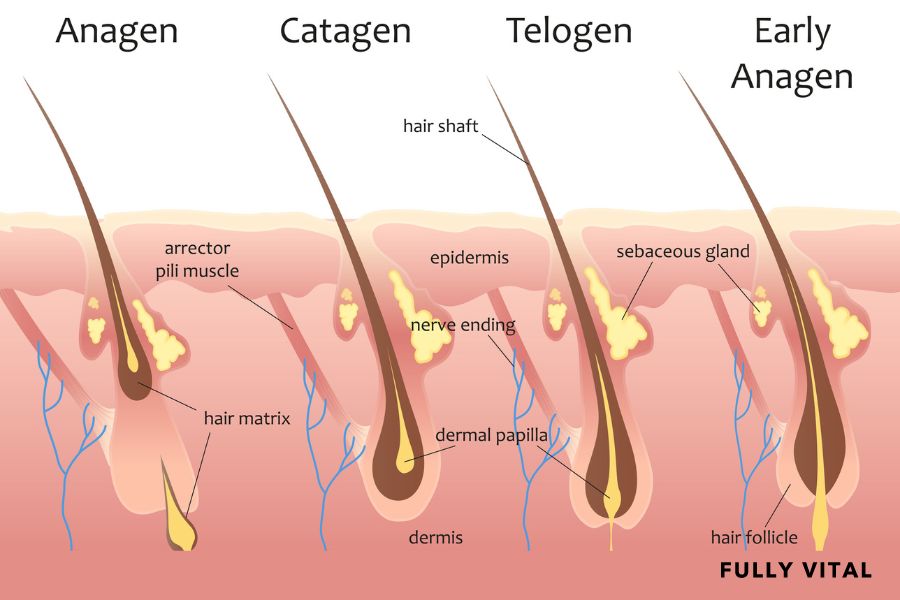
Hair grows in a repeating cycle with four stages: anagen (growth), catagen (transition), telogen (rest) and exogen (shedding). Scalp hair grows about a centimeter, or roughly half an inch, a month, and each hair keeps growing for years before it rests and falls out. At any time, most of your hairs are growing and only a small share are resting, which is why losing 50 to 100 hairs a day is normal.
This guide explains each stage, how fast hair grows, how long it takes to grow back, and what can push hair out of its growth phase early.
Key fact: Anything that affects your hair, from stress to a new routine, shows up only as new hair grows. That's why changes in shedding often appear two to three months after the cause, and improvements take months to see.

The Short Answer
- The stages, in order: anagen (growing), catagen (transition), telogen (resting) and exogen (shedding).
- Anagen lasts years on the scalp, which is what decides how long your hair can grow.
- Scalp hair grows about 1 cm (half an inch) a month, varying with genes, age and ancestry.
- Stress, illness, crash diets, deficiencies and some medications can push many hairs into the resting phase at once, causing shedding a few months later.
What Are the Stages of Hair Growth?
| Stage | What happens | Typical length on the scalp |
|---|---|---|
| Anagen (growth) | The follicle is active and the hair grows steadily | Several years, often 2 to 7 |
| Catagen (transition) | Growth stops and the follicle shrinks | A few weeks |
| Telogen (rest) | The hair stays in place while a new one starts below it | Around three months |
| Exogen (shedding) | The old hair falls out, usually when you wash or brush | Part of the end of telogen |
More on each stage: the anagen phase, the catagen phase and club hairs, the shed hairs with a small white bulb at the end.
How Fast Does Hair Grow?
About a centimeter a month on average, or roughly a third of a millimeter a day. That's about half an inch a month and around six inches a year. Growth rates vary between people. Ancestry, age, genes, hormones and nutrition all play a part, and hair on different parts of the scalp can grow at slightly different speeds.
How Long Does It Take for Hair to Grow Back?
- After a haircut or shave: it grows back at your normal rate, about half an inch a month. Shaving doesn't make hair grow back thicker or faster.
- After temporary shedding (telogen effluvium): shedding usually eases within a few months of the trigger passing, and regrowth becomes noticeable over the following months. How long telogen effluvium lasts.
- After pregnancy: shedding often peaks a few months after birth and settles within a year. Postpartum hair loss timeline.
- With pattern hair loss: hair doesn't grow back on its own, because follicles gradually shrink. How to stop hair loss.
What Pushes Hair Out of the Growth Phase?
Inflammation, hormonal changes, stress, nutritional deficiencies, poor sleep and some medications can all shift hairs from growing to resting early. When many hairs make that switch at once, you notice heavy shedding two to three months later. On the other side, good blood flow to the scalp, a healthy follicle and the right nutrients support the return to growth. Sudden hair shedding and clogged hair follicles.
Can You Make Hair Grow Faster?
Not much faster than your genes allow. What you can do is keep more hairs in the growth phase and stop them breaking: correct deficiencies, eat enough protein, look after your scalp, and be gentle with heat and tight styles. Hair that doesn't break looks like it's growing faster. Vitamins for hair growth, protein-rich foods for hair and rosemary oil for hair growth.

What the Research Shows
A 2023 review of the hair cycle (Natarelli et al.) describes its four phases: anagen, catagen, telogen and exogen. About 9% of hair follicles are in telogen at any time. Inflammation, hormones, stress, nutritional deficiency, poor sleep and medications that slow cell division can push hairs from anagen into telogen, while blood flow, direct stimulation of the follicle and growth factors help hairs move back into growth.
A study of 2,249 young adults without hair loss from 24 ethnic groups (Loussouarn et al., 2016) measured hair density, the share of resting hairs and growth rate on three areas of the scalp. It found wide differences linked to scalp area, sex and origin: on average, Asian hair grew faster and was thicker, African hair grew more slowly and was less dense, and Caucasian hair was the densest.
A 2021 review of telogen effluvium (Chien Yin et al.) describes it as a common cause of diffuse hair loss, usually set off by physical stress such as childbirth or sudden weight loss. It has a high rate of remission, although its mechanism isn't fully understood.
Supporting Each Stage of Growth
FullyVital's Hair Revival Kit 30-Day pairs a nightly scalp serum with a daily supplement. The Hair Revival Serum brings rosemary oil, caffeine, saw palmetto extract and peptides to the scalp, and Hair Revival Supplements provide vitamin D3, B12, folate, biotin and zinc. Both are designed to support a healthy scalp and growth cycle. Because hair grows slowly, the Hair Revival System 90-Day covers a full three months.
Frequently Asked Questions
What is the correct order of the stages of hair growth?
Anagen (growth), catagen (transition), telogen (rest), then exogen (shedding). The follicle then starts a new anagen phase.
How quickly does hair grow daily?
About a third of a millimeter a day on average, which adds up to roughly a centimeter, or half an inch, a month.
Can hair grow 2 inches in a month?
No. Typical scalp hair grows about half an inch a month. Products promising inches in weeks are overselling.
How much hair grows in 22 days?
Roughly 7 millimeters, or a bit more than a quarter of an inch, at an average growth rate.
How long is 7 years of hair growth?
At about six inches a year, roughly three and a half feet, if the hair stays in its growth phase that long and doesn't break.
How many hairs are on a human head?
Around 100,000 on average. The number varies with hair color and ancestry: people with naturally blond hair tend to have more strands, and people with red hair fewer.
Is losing 700 hairs a day normal?
No. Losing 50 to 100 hairs a day is normal. Much more than that, especially if it lasts, is worth checking with a doctor.
Scientific References
This guide is grounded in the following published research.
Natarelli N, Gahoonia N, Sivamani RK. "Integrative and Mechanistic Approach to the Hair Growth Cycle and Hair Loss." J Clin Med, 2023.
Loussouarn G, Lozano I, Panhard S, et al. "Diversity in human hair growth, diameter, colour and shape. An in vivo study on young adults from 24 different ethnic groups observed in the five continents." Eur J Dermatol, 2016.
Chien Yin GO, Siong-See JL, Wang ECE. "Telogen Effluvium - a review of the science and current obstacles." J Dermatol Sci, 2021.
Read more

Low Level Laser Therapy For Hair Growth: Shedding Light On An Effective Solution
Discover the transformative potential of Low Level Laser Therapy (LLLT) for hair growth on Fully Vital's informative…
Read more
Trichoscopy: Unveiling Hair Health - A Comprehensive Guide
Discover the power of trichoscopy - a non-invasive technique for in-depth scalp and hair analysis. Explore its…
Read more
